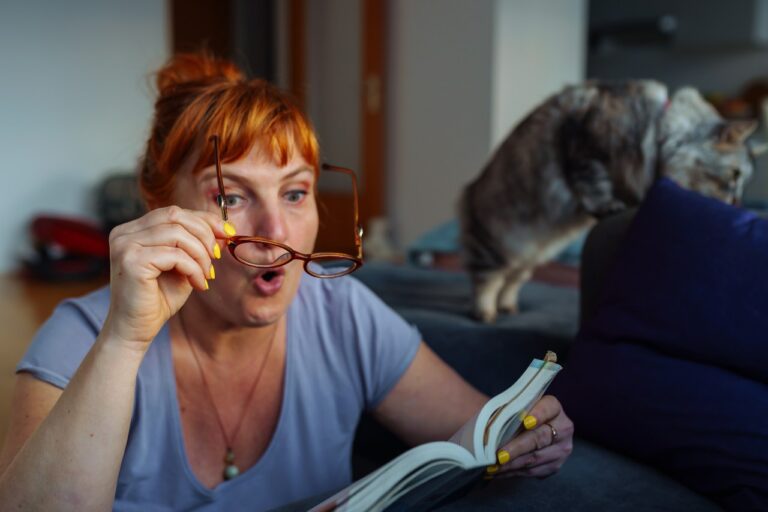
Finding yourself holding your phone further away to read it? Turning up the brightness on a menu? Or suddenly needing reading glasses when you have always had good vision?
You could be experiencing presbyopia – a natural, age-related change in the eye that makes it increasingly difficult to focus on things up close.
Presbyopia usually starts becoming noticeable during your 40s. While reading glasses are one way to manage it, they are not the only option.
Modern vision correction treatments may also help suitable patients improve their range of vision and reduce their reliance on reading glasses.

What Is Presbyopia?
Presbyopia is the gradual loss of the eye’s ability to focus clearly on nearby objects.
When we are younger, the natural lens inside the eye is flexible. It can change shape to help us switch our focus between objects at different distances; from looking across a room to reading a message on our phone.
As we get older, the natural lens becomes less flexible. This reduces the eye’s ability to focus at close distances.
The result? Small print becomes harder to read, your phone starts creeping further away from your face and reading glasses can suddenly become an everyday essential.
Presbyopia is extremely common and is a natural part of ageing. It can affect you even if you have previously had excellent eyesight.
What Are the First Signs of Presbyopia?
Presbyopia tends to develop gradually, so you may adapt to the changes before realising what’s happening.
Common signs can include:
- Holding your phone further away to bring text into focus
- Difficulty reading small print, particularly in lower light
- Needing brighter lighting when reading
- Blurred vision when looking at things close up
- Eye strain or tired eyes after reading or close work
- Headaches following prolonged near-vision tasks
- Increasing reliance on reading glasses
One of the classic signs is discovering that your arms suddenly don’t seem quite long enough when you are trying to read something.
If these symptoms sound familiar, an eye examination can determine whether presbyopia or another vision condition is responsible.

What Age Does Presbyopia Start?
Most people begin noticing presbyopia in their 40s, although exactly when it becomes noticeable varies between individuals.
You may first notice it when reading particularly small text, looking at your phone or trying to read in dim lighting.
Presbyopia then tends to progress gradually as the natural lens continues to lose flexibility with age.
It isn’t something you have caused through reading too much, working at a computer or spending too much time looking at your phone. It’s part of the natural ageing process.
Is Presbyopia the Same as Long-Sightedness?
No. Although both can make close-up vision difficult, presbyopia and long-sightedness (hyperopia) are different conditions.
Long-sightedness is a refractive error related to how the eye focuses light and can occur at any age.
Presbyopia is specifically an age-related loss of near focusing ability caused by changes to the natural lens inside the eye.
It’s also possible to have both.
This is one reason a comprehensive eye examination is important rather than assuming that difficulty reading automatically means you simply need stronger reading glasses.

Can Presbyopia Be Corrected?
Yes. There are several ways of correcting or managing presbyopia, ranging from reading glasses and contact lenses to surgical vision correction.
The right option will depend on factors including your age, prescription, eye health, lifestyle and what you would like to achieve from treatment.
- Reading Glasses
For many people, reading glasses are the simplest way to manage presbyopia. They provide additional focusing power for close-up activities such as reading a book, checking a menu or using a phone. The downside is that as presbyopia progresses, you may find yourself increasingly reaching for your glasses, and keeping different pairs in the places you need them most.
- Bifocal or Varifocal Glasses
If you already need glasses for distance vision, bifocal or varifocal lenses can provide different focusing powers within the same pair of glasses. This can allow you to see across multiple distances without continually switching between different pairs.
- Contact Lenses
Multifocal or monovision contact lenses may be another option for some people with presbyopia. They can provide an alternative to reading glasses, although they still require ongoing wear, cleaning and replacement and aren’t suitable for everyone.
- Laser Eye Surgery for Presbyopia
For suitable patients, laser vision correction may be considered to improve the range of focus and reduce reliance on reading glasses. At Centre for Sight, Supracor LASIK may be an option for some patients experiencing presbyopia. Rather than assuming laser eye surgery is suitable based on age or prescription alone, detailed diagnostic testing is required to assess the health and characteristics of your individual eyes.
Learn More About Supracor LASIK
- Laser Lens Replacement
For other patients, particularly as the natural lens becomes increasingly affected by age, Laser Lens Replacement may be a more appropriate option. The procedure replaces the ageing natural lens inside the eye with an artificial lens implant selected to provide the desired range of vision. Different lens technologies are available and your consultant will discuss which, if any, is appropriate for your eyes, visual requirements and lifestyle.
Learn More About Laser Lens Replacement
Laser Eye Surgery or Lens Replacement for Presbyopia?
This is one of the most important questions, and there isn’t one answer that applies to everybody.
Your age is one consideration, but it isn’t the only one.
Your consultant will also consider:
- Your current prescription
- Your corneal shape and thickness
- The condition of your natural lens
- Your overall eye health
- Your near, intermediate and distance vision
- Your lifestyle and occupation
- Your expectations from vision correction
For some patients in their 40s or early 50s, a laser-based procedure may be considered. As the natural lens changes further with age, lens-based vision correction may become a more appropriate option for some patients.
The purpose of your consultation is to determine which option is appropriate for your eyes, rather than expecting you to choose a procedure yourself.
If you would like to find out what’s possible for your vision, speak to a member of our team today.