Eye Health MOT

A Comprehensive Eye Health Assessment for Peace of Mind

This in-depth assessment is designed to provide a clear picture of your eye health, identify any early signs of underlying conditions, and offer expert guidance.

A smiling woman with curly grey hair holds a glass of green smoothie in a modern kitchen, wearing a black and white striped shirt. Kitchen appliances and eggs are visible on the counter, hinting at a collagen crosslinking-friendly lifestyle.

A Calm, Thorough Approach to Eye Health

With recent media coverage highlighting vision requirements for drivers, many people are understandably asking whether their eyesight and eye health are where they should be. For those who would like clarity and reassurance, Centre for Sight is now offering a comprehensive Eye Health MOT for patients aged 40 and over.

The Eye Health MOT is not a DVLA test, but a proactive, consultant-led eye health assessment that can help rule out concerns, reduce uncertainty and support informed decision-making.

Much like a full health MOT for your body, this assessment focuses on early detection, reassurance and forward planning, rather than reacting to problems once symptoms appear.

Sit in the driver’s seat and take control of your vision.

What’s Included in Your Eye Health MOT?

Your assessment includes a thorough eye test for driving using advanced diagnostic tests, followed by a consultation with one of our eye surgeons.

Vision & Functional Assessment
  • Vision testing (unaided and corrected) at distance, intermediate and near

This assesses how well you can see at distance, intermediate and near, both with and without glasses or contact lenses. It helps us understand your day-to-day visual performance and identify any changes or limitations that may affect activities such as driving, screen use or reading.

  • Full refraction

A full refraction determines the exact prescription required to optimise your vision. By carefully measuring how light focuses in your eyes, this test identifies short-sightedness, long-sightedness and astigmatism, and helps guide recommendations for vision correction or further investigation.

  • Visual field test (24-2 Humphrey)

This test maps your peripheral (side) vision and checks for any areas of reduced sensitivity. It is particularly important for detecting and monitoring conditions such as glaucoma, neurological disorders and retinal disease, even before symptoms are noticed.

Advanced Diagnostic Imaging
  • OPD-3 analysis

The OPD-3 provides a detailed assessment of how light travels through the eye, measuring optical quality, aberrations and visual performance. It helps identify subtle visual issues that may not be detected by standard eye tests and supports highly personalised treatment planning.

  • MS39 corneal scan with keratoconus screening and multiple image report

This advanced corneal scan creates a detailed map of the shape, thickness and curvature of the cornea. It includes dedicated screening for keratoconus and other corneal conditions, alongside a multiple image report to support accurate diagnosis and long-term eye health monitoring.

  • HD Analyzer

The HD Analyzer evaluates the quality of vision beyond standard visual acuity, measuring how light scatter and clarity are affected by the cornea and lens. It is particularly useful in detecting early lens changes, such as cataracts, and assessing overall visual quality.

  • IOLMaster

The HD Analyzer evaluates the quality of vision beyond standard visual acuity, measuring how light scatter and clarity are affected by the cornea and lens. It is particularly useful in detecting early lens changes, such as cataracts, and assessing overall visual quality.

  • OCT scans of:

    • Macula – This scan provides high-resolution cross-sectional images of the macula, the central part of the retina responsible for detailed vision. It allows early detection and monitoring of conditions such as macular degeneration, swelling or retinal disease.

    • Optic nerve fibre layer – This scan measures the thickness of the optic nerve fibres, which are critical for transmitting visual information to the brain. It plays a key role in detecting and monitoring glaucoma and optic nerve damage, often before symptoms appear.

  • Ultra-widefield retinal imaging (Clarus / Optos)

This imaging captures a wide view of the retina, allowing examination of the central and peripheral retina in a single image. It helps identify retinal conditions such as tears, degeneration, diabetic changes or inflammation that may otherwise go unnoticed.

Eye Pressure & Structure
  • Tonoref (intraocular pressure and pachymetry)

The Tonoref measures the pressure inside the eye (intraocular pressure) and the thickness of the cornea (pachymetry). These measurements are essential for assessing the risk of glaucoma and ensuring eye pressure readings are interpreted accurately, supporting early detection and long-term eye health monitoring.

Clinical Examination
  • Dilated eye examination

During this examination, eye drops are used to gently dilate (widen) the pupils, allowing a thorough assessment of the retina, optic nerve and internal structures of the eye. This enables early detection of conditions such as retinal disease, optic nerve damage and other underlying eye health concerns that may not be visible during a routine examination.

  • Consultant ophthalmologist examination

A comprehensive examination performed by a consultant ophthalmologist, bringing together the results of all diagnostic tests. Your consultant will assess overall eye health, discuss findings in detail, provide a clear clinical report, and outline any recommendations or next steps tailored to your individual needs.

A woman wearing a white blouse and pearl necklace smiles as an optometrist adjusts a phoropter in front of her eyes during an eye examination in a clinic setting.

Your Personalised Eye Health Report

Following your assessment, you will receive a comprehensive Eye Health Report, structured in a clear, professional format.

  • Each diagnostic test is included as an attachment
  • Consultant findings and interpretation are clearly documented
  • The final plan outlines recommendations, if any, and next steps

This report can be retained for your personal records or shared where required.

Who Is the Eye Health MOT For?

This assessment may be particularly suitable if you:

  • Are aged 40 or over
  • Want reassurance about your eye health
  • Are concerned about recent DVLA-related coverage
  • Have a family history of eye conditions
  • Would like a thorough assessment

Pricing

Eye Health MOT: £695

This includes all diagnostic tests, consultant examination, and your detailed Eye Health Report.

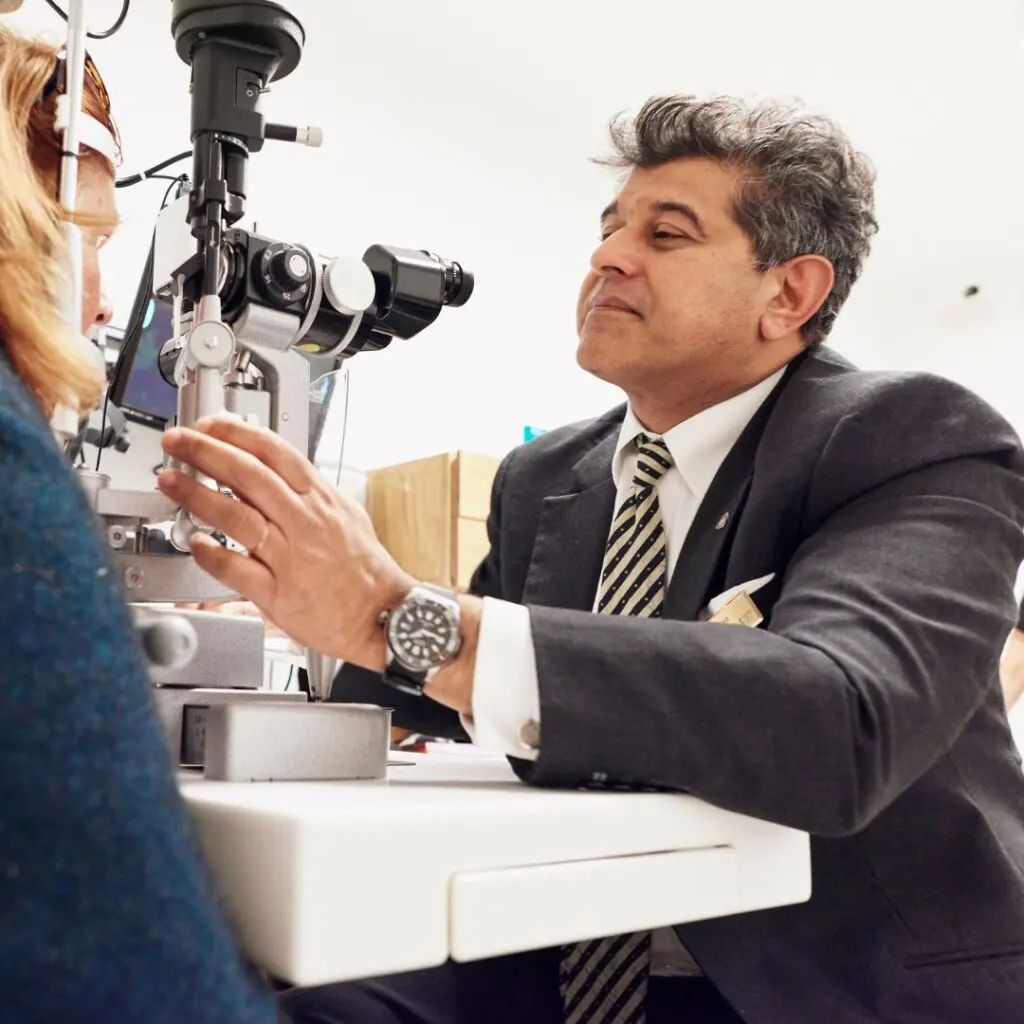
Centre for Sight Sheraz Daya looking at patients eyes and tested Medical Director