
Macular Degeneration (ARMD)
Age-Related Macular Degeneration (AMD) affects the macula, the central part of the retina, and can gradually erode central vision, making reading, recognising faces, and everyday tasks increasingly difficult. At Centre for Sight, our specialist retinal team offers expert diagnosis, monitoring and treatments to help preserve sight and quality of life.
FDA Approved
Advanced Technology
Why It Matters / Prevalence & Risk Groups
Macular degeneration is common, progressive, and often under-recognised, here’s why it matters.
What Is Age-Related Macular Degeneration (AMD)?
Age-Related Macular Degeneration (AMD) is a common eye condition that affects the macula which is the small, central part of the retina responsible for sharp, detailed vision. Over time, the macula becomes damaged, leading to blurred or distorted central vision, difficulty reading, and challenges recognising faces.
AMD typically develops in people over 50 and progresses gradually. There are two main types:
Dry AMD: The most common form. Macular cells slowly thin and waste deposits (drusen) build up, leading to gradual vision decline.
Wet AMD: Less common but more serious. Abnormal blood vessels grow under the retina and leak, causing sudden or rapid sight loss if not treated promptly.
Peripheral (side) vision usually remains unaffected, meaning AMD does not cause total blindness, but it can significantly impact independence and quality of life. Early diagnosis and monitoring are essential to protect remaining vision.
Our Centres
What are the Symptoms of ARMD?

Blurring or distortion
Gradual blurring or distortion of central vision (straight lines may appear wavy)
Difficulty reading
Even with good light or stronger glasses
Dark or empty patches
Particularly in the centre of your vision
Faded or dull colours
Slow recovery
This occurs when moving from bright to dim lighting
Faces becoming harder to recognise
Reduced contrast sensitivity
Making it harder to see fine detail

AMD affects central vision, so symptoms often start subtly and become more noticeable over time. In the early stages, many people may not realise there is a problem, but as the condition progresses, everyday tasks such as reading, recognising faces, or driving can become increasingly difficult.
Types of Age-Related Macular Degeneration
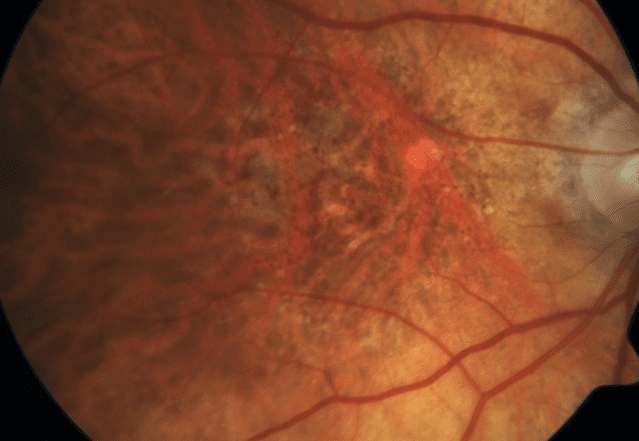

Dry AMD
Dry AMD is the most common type, affecting around 85% of people with the condition. It develops slowly as the light-sensitive cells in the macula wear down over time, causing a gradual decline in central vision.
Treatment focuses on slowing progression. A non-invasive laser therapy called 2RT can be used in the intermediate stage to help reduce the risk of dry AMD worsening or turning into wet AMD.

Wet AMD
Wet AMD is the less common but more aggressive form, affecting around 15% of people with the condition. It occurs when abnormal blood vessels grow beneath the retina and leak fluid or blood, leading to a rapid decline in central vision, sometimes within days.
Early treatment is essential. Wet AMD is managed with anti-VEGF injections, delivered under local anaesthetic every few weeks, to slow the disease and help protect central vision.
Not Sure If You're Eligible?
Schedule a comprehensive eye examination to determine your candidacy for age-related macular degeneration treatment.
Diagnosis & Assessment
Early detection is essential for preserving central vision and slowing the progression of Age-Related Macular Degeneration.
1
How We Assess Your Vision
Your AMD evaluation is carried out by a consultant ophthalmologist using high-resolution retinal imaging to assess the macula, detect early changes and monitor progression.
Duration: 60-90 minutes
What to Expect
Full vision check
Retinal imaging (OCT)
Review of risk factors
Personalised advice
2
Tests and Scans You May Have
We use advanced diagnostics to examine the layers of the retina, identify drusen, and assess for leakage, swelling or early signs of wet AMD.
Duration: 60-90 minutes
What to Expect
OTC scan
Fundus photography
Visual function tests
Consultant explanation
3
What Happens at Your First Appointment
Your first visit includes a complete retinal assessment, dilating drops (if needed), and a consultant-led discussion about your diagnosis, treatment options and monitoring plan.
Duration: 60-90 minutes
What to Expect
Dilated eye exam
Clear diagnosis
Treatment guidance
Follow-up plan
What are the Treatment Options for AMD?
While there is currently no cure for Age-Related Macular Degeneration, several treatments can slow progression, preserve central vision, and support day-to-day visual function. The right approach depends on whether you have Dry AMD or Wet AMD, as well as the stage of the condition.

Nutritional Support & Supplements
Specific vitamin and mineral formulations under medical guidance may help support retinal health and slow degeneration in early-stage AMD.
Non-Invasive Laser Therapy (2RT)
For suitable patients in the early or intermediate stage of dry AMD, we offer 2RT Laser Treatment a gentle, nanosecond-pulse retinal laser that stimulates natural repair of the retina and can reduce the risk of the condition advancing.
Medical Treatments for Wet AMD
If abnormal blood vessels develop under the retina (wet AMD), treatment typically involves regular intravitreal injections to halt leakage and protect central vision. Please contact our enquiries team for further information.
Why Choose Centre for Sight
Centre for Sight is one of the UK’s most established and pioneering eye care providers, with over 30 years of experience and multiple national firsts. We were the first clinic in the UK to perform LASIK, and among the earliest to introduce femtosecond laser technology for both laser eye surgery and cataract procedures. Our consultants have collectively performed over 35,000 cataract surgeries, delivering exceptional outcomes backed by audited results and world-class surgical expertise. Patients benefit from fully consultant-led care, advanced diagnostic technology, and personalised treatment planning all supported by our reputation as a trusted centre where ophthalmologists from around the world come to observe and train. At Centre for Sight, innovation, safety, and excellence are built into every step of your journey.
Patient Success Stories
Such great care and service here. I had a household accident last week and came to get my eye looked at, which they went out of their way to accomodate on the same morning of ringing. The team is amazing, the admin, nurses, and consultant were really kind and caring. The follow up care has also been great with calls after a week to check how I’m getting on. Everyone has been so warm and friendly, a huge heartfelt thank you!
Centre For Sight

sana ali
The best decision ever! My eye treatment at Centre for Sight has changed my life and enhanced my confidence. Having trifocal lenses implanted by Mr Sheraz Daya has restored my eyesight and I no longer need to use any lenses for reading, driving or any other activities.
From my first encounter with Mr Daya and his team at Centre for Sight, I felt most reassured that I was getting a very professional opinion and treatment. The day of the procedure was made much easier by the comforting support provided to me by Dr Espinosa whilst Mr Daya was performing my eye surgery. Overall, a fantastic experience and a great result.
Centre For Sight

Manuel Oyarzabal
Really proffesional
The professionalism I experienced right the way through the process was just brilliant. With all the testing prior to surgery, I felt very sure that I was doing the right thing. Saj Khan was not only very proffesional, he was also quite funny, which put you at ease.
Centre For Sight
Nigel Guthrie
A heartfelt thank you also to his team: Adora and Teresa, who have supported me from my very first appointment and always make me feel welcome, and Katie, Debra and Alex at Grinstead, who cared for me during surgery and helped me through one of the most anxious times of my life.
I cannot recommend Dr Daya and his team enough. For anyone who is unsure or afraid of taking this step — please know this really can change your life.
Centre For Sight
Rikesh Patel
Excellent Result
Initial tests were very thorough and the recommendations clearly set out. The operation itself was quick and painless. All the staff were friendly and professional. The aftercare was faultless.
Centre For Sight
Derek
Our Centres
London Centre

Centre for Sight London, located at 14 Queen Anne St, Suite 2, in the prestigious Harley Street area, offers consultations, follow-up care, and YAG laser procedures.

Sussex Centre
Hazelden Place, Turners Hill Road, East Grinstead, West Sussex, RH19 4RH

Arguably the most modern private eye hospital in the UK, our hospital in Sussex offers Laser Vision Correction, Corneal Transplants, Stem Cell Surgery and more.

Surrey Centre
48 High Street, Oxshott, Surrey, KT22 0JR

Centre for Sight London, located at 14 Queen Anne St, Suite 2, in the prestigious Harley Street area, offers consultations, follow-up care, and YAG laser procedures.

Latest News
Explore our most recent updates, expert insights and news from across our clinics.

Macular Degeneration FAQs
Below are answers to some of the most frequently asked questions about Macular Degeneration.
What causes age-related macular degeneration?
Over the past few years there has been a considerable amount of research about the causes of age-related macular degeneration. It is a genetic condition and several genes are known to be responsible for modifying the risk of developing it. However, large research studies have identified a number of lifestyle factors that increase the risk of developing Macular Degeneration and these include smoking, obesity, poor diet, high alcohol intake and UV light.
What causes sudden sight loss with age-related macular degeneration?
Early symptoms may include difficulty in reading, difficulty in recognising people’s faces and distortions in the central vision. The sight loss usually occurs gradually over time, although it can develop very rapidly due to sudden bleeding in the central area of the retina, the macula, with loss of central vision within a few days.
How is age-related macular degeneration diagnosed?
Diagnosis of Macular Degeneration can be achieved with just three non-invasive tests, including visual acuity measurement, dilated retinal examination and optical coherence tomography (OCT) of the macula, a novel non-invasive imaging test. Regular eye checks are vitally important for all over the age of 50.
Can the progression of AMD be reduced?
A study concluded in 2001 showed that participants with Age-Related Macular Degeneratio who took a formulation consisting of antioxidants, the AREDS (Age Related Eye Disease Study) formulation were 25 percent less likely to progress to advanced over the five-year study period, compared with participants who took a placebo (a dummy medication). Many products with the AREDS formulation are available at your local chemists.
What are the treatments for wet AMD?
The treatment of wet AMD has been transformed over the past few years by the drugs which block the vascular endothelial growth factor (anti-VEGF) including Eylea (Aflibercept), Lucentis (Ranibizumab) and Avastin (Bevacizumab).
These treatments are given as injections directly into the eye (intravitreal injections) under local anaesthetic at around 4 to 8 weekly intervals and are effective at slowing down AMD progression, preserving eyesight and limiting permanent damage on the macula.
Miss Shahrnaz Izadi, BSc Hons, MBChB, MRCOphth, FRCOphth, Consultant Ophthalmic Surgeon at the Centre for Sight and Retinal Lead at Epsom and St Helier University Hospital says “We are extremely lucky to be able to offer these new treatments for AMD, however the early detection of wet AMD always results in better preservation of sight and reduces the risk of permanent damage to the eye.”
It is also recommended that first-degree relatives of AMD patients monitor their eye health on a regular basis with simple non-invasive tests.
Have Questions?
Our patient care team is here to answer any questions you may have.